

If you follow my Victorian Dolls, Victorian Traditions, The Victorian Era and Me Blog you know that I just LOVE the Victorian Era, love history, and love to do research. In doing all of that I ran across the Metropolitan Museum of Art website the other day and fell in love with their collections, the ability to see everything they have in their collections, and the ability to set-up my own "My Met" space to bookmark items at the MET that I love.
Well, while "Moseying At The MET!" last week I came across items from their French Doll Fashion Collection and fell in love with them. Now all you have to know as to why I would fall in LOVE with them is they have to do with dolls and have to do with the fashions of the Victorian Era and periods before and after that.
They are in fact a collection of fashion dolls displaying French fashions from 1715 until 1906. There seems to be 42 dolls in the collection and they give you a wonderful picture of the way French fashion has changed through the ages.

Each of the doll pages has information of the fashion year the doll was created for, fashion designer who created it, date created, culture, medium, dimensions, credit line, and accession number. They also include a description containing information on the collection and information on the dolls design.
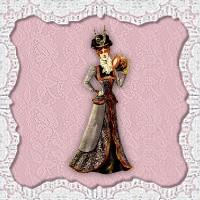
For example, the 1715 doll shown in the picture above and at the top of this post had the following descriptive information on her design: The inspiration for this dress came from the painting L'Enseigne de Gersaint by Watteau. Antoine Watteau (1684-1721) was best known for inventing the fete galante, a genre characterized by outdoor parties and bucolic scenes in idyllic settings. L'Enseigne de Gersaint was actually completed in 1720, five years after the date of the Rochas design. Watteau created this work for his friend and art dealer, Gersaint's shop, where it is believed to have hung in the window as a sign. This painting, in addition to being an interesting study of everyday life in an art dealer's shop, is an excellent example of the famous "Watteau pleats". The fashionable women in Watteau's fete gallants were so often depicted wearing this style, that they became known as Watteau pleats.
According to the Metropolitan Museum of Art the reason for the collection was as follows: - In 1947, in response to the suffering of post-World War II France, an American grassroots campaign organized a large-scale relief package. The following year France, moved by this generosity, organized a gift in kind. As the aide was sent to France housed in boxcars and dubbed the "American Friendship Train" the French created the "Gratitude" or "Merci Train", a set of 49 boxcars filled with gifts of thanks. Each of the 48 states was to receive a boxcar with the 49th shared between Washington D.C., and the Territory of Hawaii, which had contributed sugar on the Friendship Train. A wide array of items was included in these cars, from handmade children's toys to priceless works of art.
The Chambre Syndicale de la Couture de Parisienne, who, to raise money for the French people, had two years prior organized the Theatre de la Mode, a group of fashion dolls dressed in clothing from the 1947 couture collections, chose to create a new set of fashion dolls, this time representing the evolution of French fashion rather than the current season. Once again, the Syndicat tapped the most talented and well-known fashion designers, hairstylists, and accessory designers of the time to create these miniature masterpieces.
The unique design of the fashion doll, originally created for Theatre de la Mode and used again for the Gratitude Train was conceived by Eileen Bonabel, the plaster head by the artist Rebull. Each doll measures approximately 24 inches tall, with bodies made entirely of open wire. Human hair was used to fashion the hairstyles. Each designer chose a year between 1715 and 1906 for which to dress his doll. Their varying sources of inspiration included works of art, literature, and historic fashion plates. The Gratitude Train fashion dolls represent a unique moment in the history of couture as they represent not only creative interpretations of historic fashions by the greatest designers of the period, but also are infused with the unparalleled skill, care, and attention to detail that would have been applied in their full-size counterparts.
I would have to agree with the MET, but would add that viewing this collection in it's entirety would be visual eye-candy for anyone who loves the fashions of those periods.
The collection is not on display so, of course, I set-up a French Fashion Doll Collection Page and a set collection in My MET so I could view all the dolls in the collection at any time. And, if I wanted to read more on any particular design all I would need to do is click on the image for that doll's page at the MET. How great is that? I LOVE it.
Both of my pages are shown below:

My Pinterest Page - French Fashion Doll Collection

I can't quite decide which is my favorite doll of the collection as of yet. I have to read through all the descriptions first and then maybe I'll decide. Or, I'll never decide and just enjoy each of the dolls for her beauty and the attention to detail on her amazing costume.
I hope you enjoy the collection as much as I do.


 The other day my sister, sister-in-law and I decided to visit Newport, Rhode Island for a little shopping and touring of some of the mansions.
 When I think of a "Lady" either I picture someone like Audrey Hepburns' character in "My Fair Lady" or I picture a Victorian woman like the picture to the left. Someone refined and dignified. Someone who has good manners and who also just happens to be wearing a beautiful Victorian dress. I always seem to get back to the Victorian dresses, don't I? Must be an obsession. Yah think? In my mind, a "Lady" is the ultimate perfect female. But, is she really?
 Someone who has the courage of her convictions. Someone who can use her authority when it is required. Someone who can caress and comfort anyone who is in distress. Someone who can laugh with children and lose herself in their imagination once in awhile. Someone who isn't afraid to get her hands "dirty." Someone with skills who is willing to try anything, at least once. Someone who loves and respects others and wants nothing but the best for them. Someone who tries to see the good in others. Someone who will try her best to help others succeed. Someone who will accept others with all their faults and love them just the same. Someone who always tries to put her best foot forward, but isn't afraid to fail. Someone who can see the beauty in life. Someone who doesn't judge others by their pocketbook or social standing. Someone who can stand tall and be dignified at the same time. Someone who allows herself to be "human." Someone who doesn't define herself by her gender and doesn't allow others to do so either.
 Childhood tea parties with ones dolls and friends were just so delightful. Weren't they? Not only did you get to have all your dollies around you, but you also got to play dress-up, too. I can remember having tea parties as a child. Sometimes it was just my dollies and me, but that was okay. They were always great company. I'd serve my dollies tea in one of my tea sets. They would carry on about this or that. We'd have a grand old time.
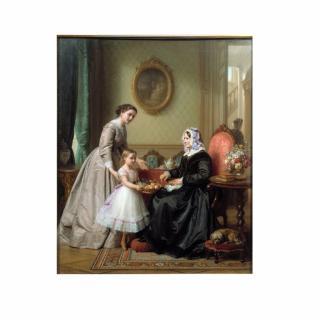 In case you've never heard the word "etiquette" it means "The body of prescribed social usages" and "Any special code of behavior or courtesy." In a polite society it is the way in which individuals deal with each other socially. It is a set of rules of good manners and behavior that changes with the times. Etiquette contains rules for the simplest actions ( such as, "Hello" or "How are you?") to rules for the most elaborate social event.
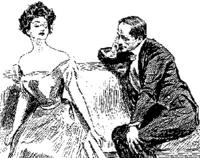
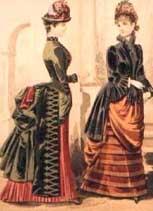 I have to wonder sometimes why I have such a fascination or passion for the fashions of the Victorian Era when I am clearly a feminist (the ultimate feminist according to my son-in-law).
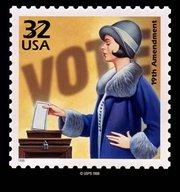 I love to just browse thru history books, genealogy records, and the encyclopedia. Browsing thru the Wikipedia encyclopedia I came across the women's suffrage stamp (see picture on the left). In looking at the women's suffrage stamp I got to thinking about my great, great Aunt "Flossie" and my Grandmother "Dee." Why did these two women come to mind when I saw the stamp? They came to mind because they grew up during the time that the women's suffrage movement was at its peak.
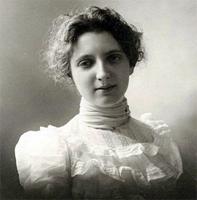 My "Flossie" Victorian doll is named after my great, great Aunt Florence (who is shown on the left). My great, great Aunt Flossie was born in 1882 and was the first women to go to college in our family. She graduated from Tufts University in 1904. She then went on to be one of the first women to work for the State Department of Corporations and Taxation. She worked for the state until she retired in 1947.
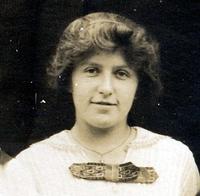 My great, great Aunt "Flossie" was a true believer of women's rights, as was my Grandmother "Dee". Both women were very intelligent and were very strong women. Both were very confident in themselves and both held strong beliefs and convictions. They both were believers in women's rights. Their beliefs definitely had a profound affect on my mother which, in turn, had an affect on me.


