I have loved dolls, history, and the Victorian Era since I was little and can credit my grandmother for that. As a young girl she gave me a Godey’s Fashion print for August 1870 from my great, great Aunt Flossie. I was captivated by the dresses and became hooked. I just love to research everything and anything about the Victorian Era. I also love to design Victorian dolls. I hope you enjoy my Victorian Dolls, Victorian Traditions,The Victorian Era, and Me blog.

Saturday, September 22, 2007

My Favorite Victorian Lady Doll Design Needs A Name

While I was taking pictures for all 1,496 of the dolls and crafts that I have made I decided to take pictures of my favorite Victorian doll design.

She was made for me to use as the Spring and Summer display that I have on the cabinet in my front hall and is not for sale.

Every season I change the front hall display and she stays there for the two seasons which suits her just fine.

Of course, my sister also loves her and I have to be careful that when she comes to visit during the Spring or Summer that she doesn't steal her. She keeps threatening too.

I told her that she can't have her. But, I half expect to see her hanging out of one of her suitcases.

So, she says, "Fine, then I'll take my namesake." Her namesake is similar to this doll and is the doll I used for my Debra (LW027) pattern. She, however, is in a very fancy faux blue suede and white lace outfit. She's beautiful, too, just not as much of my favorite as this one is.

I keep telling my sister that she can't have her either as she was the doll I used for my Linda Walsh Originals pattern so I have to keep her to support the pattern.

The last time I told my sister "no" to both of these dolls she presented me with a list of 54 of my handmade dolls and crafts that she would take instead. All FREE, of course. Isn't family wonderful! I keep telling her that I'm still reviewing her list. I didn't tell her that I tried to burn it! LOL LOL

I told my sister after I made her namesake that she was the largest Victorian I had made and was a pain in the.....! So, I named her after my younger sister, Debra. Ha! Ha!

However, I did clarify that the pattern was a pain. You, my wonderful sister, are not. Well, let me clarify that. You no longer are. When you wanted to play "Barbie" with my best friend and I you were. Of course, you were only about 4 or 5 then.

In any event, I'm getting off track again. Back to the Victorian doll. Since faceless Victorians are my favorite she, of course, is faceless. I do hope you like her.

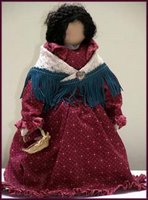
She is a 27” Victorian doll wearing an 1853 walking dress. She has a fancy lace and ruffled trim lined navy jacket with double stand-up collar and mid-length gathered and lace decorated sleeves. Her jacket is also decorated along all the edges with lace trim - inside and outside. The outside is flat lace while the inside is gathered lace that hangs down below the bottom hemline. The jacket is waistline length and ties in the front with two sets of ribbons.

Her dress is bi-colored with the upper being white and the bottom being a coordinated blue & white fabric. The dress sleeves are gathered and the sleeve cuff is the same fabric as the lower part of the dress. The lower part of the dress is three tiered with two over skirts. The top over shirt and second over skirt tier are each decorated with gathered lace. Each over skirt tier is gathered at the waistline and the second over skirt tier is also gathered up the front center line and back center line. There is 4Th level of gathered lace around the waistline of the dress. The upper part of the dress is adorned with two small silk floral decorations.

She has a very fancy multiple-tiered gathered lace & floral trimmed lined hat covered with white and peach silk flowers all along the top of the hat. A large band of the lower dress fabric is used to secure the hat to the head and is tied under her neck in a large bow just to the left of her chin.

Her red wool rove hair is tied in a large bun along the backside of her head and semi-covered by her hat.

She also has a lace trimmed slip underneath her dress. One of my sister-in-laws Mother's old peach colored lace scarf is draped around her shoulders as a shawl.

Her arms are wire-shaped and covered and she is wearing lace gloves. She also has a fabric covered head and covered square wood base. Her inner body is supported by a dowel and is covered with fabric and lace. She is stuffed with a ton of old bits of fabric to mimic some of the dolls of old days.

As of this date my favorite Victorian doll still does not have a name so I thought you might all like to help me name her. You could submit a name by leaving a comment on this post and then we could all vote on the names. Sound like fun?

So, what do you think I should call her?

Thursday, June 29, 2006

The Innu Tea Doll


In researching my article on "faceless" dolls I came across a type of doll that I had never heard of before who has a fascinating history. The dolls are called "Innu Tea Dolls" and were made by the Innu people from Nitassinan (Quebec and Labrador) Canada. The Innu have been making dolls for a very long time.

According to history the Innu people were always on the move. As such, space to carry items was always at a premium. When the Innu people traveled to their hunting grounds everyone had to carry their fair share, including the children. Innu women would sew the dolls and stuff them with tea. The tea dolls were intended to be carried by the children and would hold two or three pounds of loose tea. When the main supply of tea ran out, the dolls were opened and the tea inside was shared. The dolls would then be stuffed with caribou moss to retain their shape and then given to the children as toys.

The illustration at the top of this article is of an Innu Tea Doll that was given to the Smithsonian Institute by Lucien M. Turner in the early 1880's. According to the Innu.ca website he obtained some of the Innu Tea Dolls from the Innu people who came out of the Hudson Bay Company post to trade. The Innu of Labrador are the last known hunter/nomadic people of North America.

I hope to visit the Smithsonian one of these days. That is, when I'm not crafting or sewing. When I do I'll be sure to look for the Innu Tea Doll.


Friday, April 14, 2006

Happy Easter

Easter - the end of the winter and the beginning of spring. What a wonderful time of the year. When I think of Easter I think of Easter outfits, Easter baskets, church services, and Easter lilies.

My favorite, of course, is Victorian Easter dresses. Second to that is the Easter lily. I can remember coming home each Easter from church with an Easter Lily. I loved them then and I love them now. In fact, I have a garden filled with them along with tiger lilies, daffodils, tulips and day lilies.

The reason my garden is filled with them is because each Easter my Mother brings one to me . After the blooms are gone I plant it in my garden. That way, every year I get to marvel at the sheer beauty and delicacy of its blooms. They are magnificent.

The lily is a symbol of purity because of its whiteness and very delicate form. It symbolizes innocence. It's called the Easter lily because the flowers bloom in early Spring, around Easter. The white lily, or Bermuda trumpet, was brought to the United States from Bermuda in 1880 by Mrs. Thomas P. Sargent of Philadelphia, Pa. It has become the mainstay of Easter floral arrangements and church decorations.

If you have an Easter lily or have been given one make sure that you plant it in your garden. That way you'll see it bloom time and time again. So, each year you can't help but marvel at its magnificence.

We hope everyone has a very Happy Easter.

Graphics - Courtesy of Becky at www.primsandstems.com

Tuesday, April 11, 2006

"In Your Easter Bonnet, With All The Frills Upon It....."

If you are a baby boomer, like I am, then you probably have many fond memories associated with dressing up in your finest attire (hopefully, new clothes) for Easter Day. I know that I do.

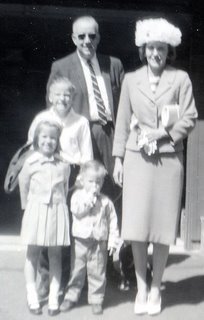
On of my favorite Easter Day pictures is the one to the left. The picture is of my mother, father, older brother, younger sister and younger brother just before going to church on Easter Day. I was taking the picture.

You might be wondering why it's one of my favorites. Well, just look at my older brother's smile - or grimace might be a better description.

And, then, of course there's my mother's hat. It was this big, white, floral, lace, ribbon concoction. Oh, sorry, mom. I meant hat. It was lovely... WINK! WINK!

Every time I look at this picture and my mother's hat I can't help but think about the words from Irving Berlin's 1948 song "Easter Parade."

"In your Easter bonnet, with all the frills upon it
You'll be the grandest gal in the Easter parade.
I'll be all in Glover, and when they look us over
We'll be the proudest couple in the Easter parade."

If you're a reader of my Linda's Blog then you know that I just love historical traditions. So, of course this got me to thinking about the tradition of Easter clothes and the Easter parade. Where and when did this all begin? Where did the wearing of new clothes come from?

Early Christians believed the week before Easter was a good time to be baptized and called it "White Week." They dressed in new white robes, which they wore during the entire Easter week to symbolize their rebirth and new life. People who had been baptized previously wore new clothes on Easter to symbolize they shared in this rebirth and new life.

Subsequently, Europeans came to believe that a new piece of clothing on Easter Sunday would bring good luck. Old or used garments would bring a year of misfortune. So new clothes became a symbol of Easter. It's unbelievable how many traditions we still have based upon superstition.

It wasn't until the Middle Ages that people in their new clothes began to take walks after their Easter service. This eventually evolved into the tradition of Easter Parades, of which New York's 5Th Avenue is probably the most famous.

After the Civil War Easter was known as the "Sunday of Joy." Women and girls who had worn dark colors of mourning during the war decided to start wearing the bright and wonderful colors of spring. Their hats were decorated with fresh flowers. If the fresh flowers weren't available then they would make flowers out of paper, fabric, ribbons, feathers, hairs, etc.

The Easter Parade in New York began in 1860 - the Victorian Era, of course. The elite of society would attend Easter Service at one of the churches along 5Th Avenue and then parade down 5Th Avenue afterwards to give every one a chance to view their new Easter hats and dresses. I would have loved to have seen that. Some of the dresses had to be absolutely gorgeous. And, of course, there were the hats.

The hats were elaborate and kept getting bigger and bigger and bigger with each passing year. Flowers, lace, bird's nests (that's something I definitely want in my hat), ribbons, etc. were all used to decorate the hats. The more elaborately decorated the hat, the better.

Of course, the first Easter bonnets were worn way before Easter was even celebrated. They weren't even bonnets at all. They were circles of wreaths of leaves and flowers and were worn atop the head to celebrate Spring. The round shape symbolized the sun and the life cycle.

In essence the Easter Parade along 5Th Avenue was the forerunner of what is known today as a "fashion show." Many seamstresses would bring their sketch pads with them to the Easter Parade so that they could go back and create knockoffs for their less wealthy clients.

Even as a child I loved Easter. Why? For me it had to do with my fascination for beautiful dresses. My mother would buy me the most beautiful little girl's dress for Easter. I'd have my hat or bonnet (of course), my black patent leather shoes, white lace socks (the tops had to be lace, of course), my white gloves (oh, yes I wore gloves), and my little purse. I don't remember what I carried in that purse. What possible needs did a little girl have. Maybe I kept my candy in there. In any event, as you can imagine I loved it.

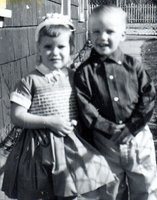
The picture to the right is of my older brother and I on Easter Sunday. Just look at my dress. I actually remember that dress. The front bodice had the most beautiful smocking and there were several layers of tulle underneath to keep the skirt puffed out. If you've never worn a dress with tulle you can't imagine how itchy it was. If you look closely my hat was a headband adorned with flowers and I think I was carrying a lollipop. Maybe that's what I kept in my purse. My brother, of course, was all decked out in his finest too. We probably walked around our house for our Easter Parade.

Another fond memory I have of Easter attire is the first year I wore high heels. What a disaster that was. I never got the hand of it and still don't know how women wear them. I kept falling off the side of the high heels. For me, given that I'm a tall women, that was comical to say the least. So flats or shoes with wide heels became my shoes of choice.

As with many wonderful traditions, new Easter outfits are a thing of the past. Some people do buy new clothes and some places have Easter parades as a lark. For me, I will always have the fond memories of my beautiful Easter dresses, and then there's my mothers hat. That hat! She could have had an eagles nest in it. Just kidding, Mom. It was lovely... WINK! WINK!

Sunday, April 9, 2006

Who Doesn't Love Bunnies?

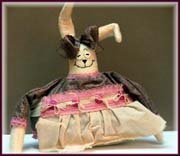
Who doesn't love cute, cuddly bunnies. Crafters and doll makers certainly do. When a crafter thinks of Easter or Spring they generally think bunnies and eggs. They've become a staple of Easter and Spring.

Why? Because like many other items crafters can do so many things with them. They can be Victorian, Primitive, Country, even Shabby Chic. They can be made of fur, cloth, wood, metal, just about anything. They can be colorful or bleak. They can have clothes or no clothes. They can be cuddly or firm. They can be standing, sitting, even hopping. They can be toys, dolls, knick-knacks, graphics, cartoons, candy, signs, pictures, etc. Just about anything you can imagine. The sky's the limit.

So, where did all the fascination and tradition of bunnies being associated with Easter and Spring begin. As with a lot of our traditions bunnies (or really, hares) have their origins in pre-Christian or pagan folklore. They served as symbols of abundant new life in the Spring. It was decided that Easter would always be the first Sunday following a full moon. So, since the moon was used to determine the date for Easter and the hare was the Egyptian symbol for the moon, hares became associated with Easter. Hares are nocturnal like the moon and carry their young for a month before giving birth, which is like the changing moon with its monthly full moon. It was also believed that the hare always kept its eyes open, watching the moon.

According to some pagan folklore, the Easter bunny was originally a large bird belonging to the goddess Eostre. To entertain her children she magically changed her favorite pet bird into a hare, which immediately laid colorful and magical eggs. So, because the Easter bunny was really a bird at heart he continued to build a straw nest and fill it with eggs.

Eggs were dyed and eaten during the Spring festivals in ancient Egypt, Greece, Persia, and Rome and were given as gifts to celebrate the coming of Spring. In all cultures the egg symbolizes the beginning of life or the universe. The early Christians didn't feel that the pagan custom of coloring eggs was harmful so they kept that pagan tradition and applied it to their own festivities. Some speculate that missionaries or Knights of the Crusades were responsible for bringing the coloring of eggs westward.

The earliest known reference to a modern Easter Bunny appears in German writings in 16th century Germany. In medieval times eggs were traditionally given at Easter to the servants. The first edible Easter bunnies were made in Germany during the early 1800's and were made of pastry and sugar.

In the 18Th century, German settlers brought the Easter Bunny tradition to America. The white Easter Bunny was called "Oschter Haws" or "Osterhase" and brought gifts of chocolate candy to good children. The children believed that if they were good the "Oschter Haws" would lay colorful eggs for them in a nest the children had built, which was usually a hat or bonnet that was placed in a secluded place like the barn or the garden.

Placing the hats or bonnets in secluded places eventually lead to the Easter Hunts. On Easter morning the children of the house would join together in a search for the eggs that the Easter Bunny had hidden while they were asleep.

By the 19Th century the Easter Hare became the Easter Rabbit. Plastic Easter eggs made their debut in the early 1960's with more than 1 million plastic eggs being purchased each year for Easter. American families would later change the tradition of the nest into using baskets and giving chocolate as well as money. And, today, we know how commercial all of this has become. Easter baskets are no longer just filled with candy eggs. It's amazing how a simple tradition has become such a commercial affair.

In any event, now you know why bunnies are associated with Easter and Spring. I suspect that crafters will continue with their love affair with bunnies for a long time to come. They're just so versatile. Besides, how can you not love a bunny? They're just so cute, so cuddly, so fuzzy, so warm, so....

Oh, here comes Peter Cottontail!
Hopping down the bunny trail,
Hippity hoppity, Happy Easter Day!"


Graphic courtesy of Becky at www.primsandstems.com

Wednesday, March 15, 2006

The History Of Faceless Dolls


If you're a reader of my Linda's Blog then you know that I just LOVE research. In thinking about my recent post on my Victorian "faceless" dolls I started to wonder exactly what the history of faceless dolls was. So, of course I had to find out.

I figured that there had to be a history of faceless dolls or, at least, some cultures and norms. Believe it or not but there isn't a lot of information on either the history of faceless dolls or cultures and norms that started such a tradition.

There is some information on two of the most popular and widely known faceless dolls - Amish dolls and Corn husk dolls. And there is the legend surrounding Raggedy Ann and "faceless" dolls. I was also surprised that there wasn't more information on "faceless" dolls throughout history. I thought for sure that they had to have been around for a long, long time.

In doing my research, what I was pleasantly surprised with was the application of "faceless" dolls for so many current charities or organizations. More on that a little later.


Probably the oldest legend has to do with "faceless" Corn-husk dolls. Some say they are the oldest form of doll known in America. The corn-husk doll shown to the right is a picture of a corn-husk doll that is in the USU Museum of Anthropology.

According to Iroquois legend the Iroquois people had three sisters - corn, beans, and squash or the "sustainers of life." The corn spirit wanted to do something extra for her people so the Creator allowed her to create a beautiful doll from her husks which was to roam the earth and bring brotherhood and contentment to the Iroquois nation. The doll went from village to village playing with the children. Everywhere she went everyone would tell her how beautiful she was.

One day this very, very beautiful doll went into the woods and saw herself in a pool of water. She saw how very, very beautiful she was and this caused her to become very vain and naughty. Kind of sounds like my "Celia" doll, doesn't it? Anyway, the dolls vanity and attitude did not sit well with the people or the Creator. The Creator warned her that this was not the right kind of behavior. She paid attention for a while (as all dolls do) but caught sight of herself in a pool of water again and thought to herself how beautiful indeed she was.

Suddenly out of the sky came a giant screeching owl that snatched her reflection right out of the water. When she looked again at the poll of water she saw nothing. This was her punishment. She would have no face and would roam the earth forever looking for something to redeem herself. Iroquois mothers passed the legend and "faceless" corn husk dolls down to their children to remind them that vanity is a bad thing and that they are not better than anyone else.

The Amish have strong religious beliefs which influence their daily lives. Their dress is plain and simple and so are the dolls they make for their children. According to the Amish tradition, the Bible says that you are not supposed to make anything that is in the image or likeness of a male or female. For that reason the dolls are "faceless."

In some Amish homes even "faceless" dolls were forbidden. Instead of a doll the children were given a piece of wood wrapped in a blanket. Since very few toys were allowed in an Amish household, boys and girls both played with the dolls. Both boy and girl dolls were made.

If you were to examine an old Amish doll you might see 4 or 5 layers of cloth on the head or the body. If the doll became too dirty, ripped or worn then it was covered with a new piece of material.

Most Amish women have been making dolls ( faceless and with faces) for their children for generations. This tradition has become a cottage industry for the Amish community. The picture top and left is of a popular "faceless" Amish boy and girl doll.

Over 20 years ago I bought a similar set of "faceless" Amish dolls. My dolls had on burgundy and black outfits but, pretty much, looked like the picture. I would have included a picture of my two "faceless" Amish dolls in this article but I can't remember where they are right now. They're here somewhere.

As far as Raggedy Ann is concerned, one of the legends surrounding her creation is that a little girl was rummaging around her Grandmother's attic and finds a faceless, battered old doll. She brings the doll into her fathers art studio and tells him all about finding it in the attic. He looks at his daughter and the faceless doll and decides to draw a whimsical face on it and then tells her to see if her Grandmother would sew two button eyes on. And so Raggedy Ann was born.

In doing my research on faceless dolls I was delighted to run across some websites concerning the application of "faceless" dolls today and why they were chosen or made "faceless." One of the websites concerned the Children With Aids Project (CWA) which was created by Joy and Jim Jenkins. CWA offers a variety of services to children infected or affected by AIDS. One of these services is giving "faceless" dolls to the children infected or affected by Aids. Why did they decide to make and sell "faceless" dolls. Because AIDS is a "faceless" disease. According to their CWA website, by buying one of the dolls you can support their mission to recruit families to provide loving, caring permanent homes for the HIV infected, affected and orphaned children.

Another article about "faceless" dolls concerned the dolls of Gloria Larocque. She has created 100 or more "faceless" dolls based upon the Iroquois legend that warns young girls about the dangers of vanity. According to the article her purpose, however, is different. Her dolls represent Canada's murdered aboriginal women, a group made faceless not by vanity but by neglect. Her project has helped draw attention to the plight of the murdered aboriginal women.

On the Girl Scouts of South Jersey Pines (GSSJP) website there was an article about a Girl Scout who made and donated 32 faceless dolls to the Pediatrics Department of the Salem Memorial Hospital to help ease the childrens fears of being in the hospital. The dolls were made out of muslin with bright striped and tye-dyed polar fleece t-shorts. The faces were left blank. Attached to each doll was a piece of paper that told the child to "give the doll a face to make it their own."

And, finally, there was article by Brenda Tobias on the Cornell University website concerning Hurricane Katrina and something the alumni did to help the children affected by Hurricane Katrina. A group of 100 alumni got together to sew "faceless" dolls for the children. Doll decorating kits and coloring books were assembled and sent to the children to comfort them.

I think you all know that I, personally, love faceless dolls. Victorians, primitives, country style. It doesn't matter. I love them all.

Why do I love the faceless doll so much? Because I think be being "faceless' the doll can be anything you want him or her to be.

You create the dolls personality to be exactly what you want it to be.

And, as we've seen from the above mentioned articles the application can be heartwarming, meaningful and beautiful.

Monday, February 13, 2006

Happy Valentine's Day

Happy Valentine's Day, tomorrow, to all the "young at heart" lovers of the world. I said "young at heart" so that no one would feel left out. Young, old, single, married, anyone with a pulse!

I actually think Valentine's Day is really for all the young lovers of the world who somehow feel like they have to show the person they love just how much they love them. And, I think it's become way too commercial. I just don't like being told I have to openly express my feelings towards the people I love on a certain day or buy them expensive gifts because someone has decided that we should.

For my husband and I, we prefer to think of every day that we have each other as Valentine's Day. Unconditional love, compliments, hugs, lingering kisses, thank-you's, "I Love You's!" for no reason, gentle caresses, smiles when you least expect it, words of encouragement, unexpected presents, help with the chores, impish looks, laughing with each other, loving glances, finishing each other's sentences, holding hands, counting on each other, loyalty, that glint in the eyes when you look at each other, and tender looks each and every day are a thousands times more meaningful than a card or a present or an elaborate holiday on Valentine's Day. That's us. Some of you may disagree.

When I was a child Valentine's Day was exciting because they always made it seem like a special event in school. You had to buy your little box of Valentine's and make one out for everyone in your class. Special ones had to be saved for special people like "Mommy" and "Daddy" and the rest of your family. You had to have your little candy hearts with the sayings and one went in with every Valentine's Day card. Sometimes special people got two. Then, we'd hand them out in school and you'd count how many you got. The "most popular" kids always got the most.

I never really thought too much about that until one year when there was a young girl in my class who was not well liked. That year she only got a few. Yes, one was from me as my Mother's rule was that everyone in the class gets one or no one gets one. From that day on it hit me that a public display like that could be very, very hurtful for some children. I had never thought about that before. I did that day. And, the effect has never left me. I can still see her crushed face and big, tearful eyes. Forty-five years later I don't remember her name but I remember her face and how devastated she was. If it had that effect on me I can't imagine what effect it had on her.

Maybe that has something to do with my attitude towards Valentine's Day. In any event, given that I love research - and readers of my Linda's Blog know that I do - I thought I'd do a little research on the history of Valentine's Day.

From what I understand from the historychannel.com and Wikipedia.com the roots of Valentine's Day can be traced back to a Catholic Feast Day, in honor of Saint Valentine. As with so many other traditions it started with a pagan tradition. For 800 years before Valentine's Day was established the Romans had practiced a pagan celebration in mid-February commemorating young men's rites of passage to the god Lupercus.

During the festival the names of women were placed in an urn. The city's bachelors would then each choose a name out of the urn and then become paired for the year with that woman. Guys today might think that was pretty good deal. There were no strings attached but, the matches often ended in marriage. So, Pope Gelasius declared February 14Th, St. Valentine's Day around 498 A.D. However, the Roman pagan "lottery" system was deemed unchristian and outlawed by the Church. Instead of the names of young women, the box would contain the names of saints. Oh, boy. Can't you see the guys all lining up for that? Both men and women could draw from the box. The idea was to try and emulate the saint who's name they drew during the rest of the year. Needless to say the young Roman men weren't happy with this change. So, the Church decided that instead of Lupercus they needed a more suitable saint of love to take his place. Enter Antonio Banderas or, for me, Brad Pitt!

As the legend goes Valentine was a priest who served during the 3rd century in Rome. At the time, Rome was ruled by Emperor Claudius II. He was a ruthless ruler who involved Rome and its citizens in many bloody and unpopular wars. Emperor Claudius II was having a problem recruiting married men to his army and decided that all the single men made better soldiers than the men who were married and had families. So, he decided to outlaw marriage for young men. Can you imagine someone trying to do that today? In any event, Valentine thought that this was unfair and decided to defy the emperor and perform marriages in secret for young lovers. Of course, when Valentine was discovered he was put to death. He was stoned to death and then beheaded. He suffered martyrdom on the 14Th of February about 270 A.D.

Another legend has it that Valentine, while he was being imprisoned by Emperor Claudius II, sent the first "Valentine" greeting himself while he was in prison. It's believed he fell in love with the blind daughter of his jailer who visited him often. Valentines great love for her and his faith managed to miraculously heal her from her blindness before he was executed. Before his death he wrote her a letter and signed it "From Your Valentine."

After the lottery was banned Roman men still sought the affection of women (what a surprise). So, it became a tradition for the men to give the women they admired handwritten messages of love and affection containing Valentine's name.

The first Valentine card was sent in 1415 by Charles, Duke of Orleans to his wife while he was imprisoned in the Tower of London. Maybe there's something to being imprisoned that causes men to write valentines!

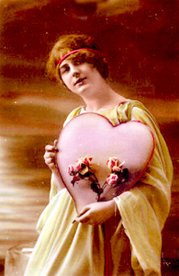
Valentine's Day didn't get imported into the U.S. until the 19Th century and was brought by British settlers. Most of the valentines back then were hand written. The 1st mass produced valentines were on embossed paper and were sold around 1847 by Esther Howland of Worcester, Massachusetts. Her father had a stationary store and she loved an English valentine she had received so she decided to create her own. She made her elaborate creations with real lace, ribbons, and colorful pictures known as "scrap." Kind of sounds like today's version of scrapbooking. The picture to the right is a Valentine's Day postcard, circa 1910.

During the second half of the 20Th century the giving of all manner of gifts was included with the valentines. Starting in the 1980's the diamond industry began to promote Valentine's Day as a day to give fine jewelry. What a surprise. And, if you'd like a statistic to support how commercial it's become - how about the fact that 1 BILLION valentine cards are sent each year. That makes Valentine's Day the second largest card sending holiday of the year. In comparison 2.6 billion cards are sent at Christmas. And, this may surprise you, 85 present of all valentines are purchased by women. Are they buying them for themselves I wonder? Hmm.... It started out with men giving them to women. Now is it women giving to men? If not men, then who?

So, is it too commercial? You do the math. One billion cards - that's a huge $$$$ making industry just in cards. Is it any wonder that the florists, the diamond industry, the restaurants, the hotel chains, etc. have all joined in. They want a piece of the action, too. Now, Valentines Day is not complete without the card, the flowers, the jewelry, the restaurant, and the romantic getaway. No wonder I think it's way too commercial.

So, for all of you who are in love with the idea of Valentine's Day I wish you a "Happy Valentine's Day!" For those of you who are still young at heart I leave you with a few Valentine's Day riddles:

What did the stamp say to the envelope? Stick with me and we'll go places.

What happens when you fall in love with a French chef? You get buttered up.

Knock, knock. Who's there? Justin. Justin who? Justin time! Here's your valentine.

Knock, knock. Who's there? Oscar. Oscar who? Oscar if she likes me!

and, finally - What did the boy elephant say to the girl elephant on Valentine's Day? I love you a ton! I think I'll go tell my husband that one.

Happy Valentine's Day from Linda graphic above - Courtesy of Snowdreamz.com

Friday, December 23, 2005

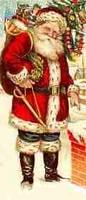
Yes, Linda, There Really Is a Santa Claus!

I can remember my Mother telling me that, as I'm sure most of you can too. We all know Santa as the familiar image with his red suit, sled or sleigh, reindeer's, and sacks of toys delivering packages to "all the good girls and boys!" I love the Christmas season and I always have. It is by far one of my favorite times of the year.

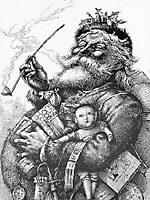
The familiar image of Santa Claus is an American invention that first appeared in a drawing by Thomas Nast in Harper's Magazine in 1868 (see picture on the right). Thomas Nast helped create the kinder, more fatherly, plumper Santa as we know him today. But, Thomas Nast wasn't the only person to contribute to this legend. Clement Clarke Moore was a huge contributor as in 1822 he published his poem "A visit From St. Nicholas," bittern known as "The Night Before Christmas." His poem is the first mention of a sleigh powered by "eight tiny reindeer" and mentioning their names.

The legend of Father Christmas, however, is ancient and far more complex. Part of the legend is attributed to St. Nicholas and part to a jovial medieval figure in the "Spirit of Christmas." In Russia, Father Christmas carries a piglet under one arm. St. Nicholas is also know as Santa Claus, Father Christmas, Heilige Nikolaus, and Pere Noel.

In the early part of the 19Th century there was a revival of a Viking tradition of a jovial, winter figure who was associated with the winter festival. He was referred to as the "Spirit of Christmas." It was believed that by inviting him in through the "front door" to join in your holiday feasting, that the winter would be kind. The "Spirit of Christmas" was subsequently renamed "Father Christmas". Instead of him visiting through the front door, his visits were to be a surprise, with him arriving during the night and down the chimney. Victorian children would write letters to him and then throw them into the fireplace. Why burn the letters? Because, my dear, Father Christmas can read smoke.

But, where did St. Nicholas really come from? It is said that St. Nicholas was born in 245 A.D. in Patara near Fethiye and died in 326 A.D. having spent his life in Anatolia (which I believe is in Turkey.) St. Nicholas was the son of a wealthy family and had a good education. He became the Bishop of Demur, trying to solve the problems of his people in a most humane way. He devoted himself to mankind. He was known as the protector of children and sailors. In a number of countries the death of St. Nicholas is commemorated by the giving of presents to children.

But, how did the legend really begin? Well, it is said that St. Nicholas heard of a family with three daughters who were unable to wed as they had no dowry. St. Nicholas had come from a wealthy family and had given up all his worldly possessions to become a bishop. He took 3 bags of gold coins and dropped them down the family's chimney. The coins landed in the girls stockings that had been hung to dry on the fireplace (ah, that's where stockings come from!) St. Nicholas was caught in the act by the girls father, but he begged him to keep his secret. Two days later, however the entire village heard of his gift and so the tradition of stockings and St. Nicholas began.

In 1951-1955 St. Nicholas became synonymous with Santa Claus and in 1955 a Father Christmas stamp was issued. St. Nicholas devoted his life to his love of humanity, love for people of all different religions and beliefs. Most of all, his love for peace, friendship, and brotherhood.

Santa Claus, Father Christmas, or St. Nicholas is also a favorite of all crafters and doll makers. Why? Because we can make him anything we want him to be. Jovial, fat, skinny, Victorian, woodland, primitive, ugly. It doesn't matter. We love them all. Well, at least I do.

But, no matter what Santa Claus looks like the message is always the same. "Ho!Ho! Ho! Merry Christmas!"

So, this Christmas season when you are hurrying around to get everything done and are fighting the crowd of shoppers just remember that St. Nicholas's message is one of peace, love, and humanity. Slow down, take a breath, and enjoy the season. And, remember these words from a very old, wise, good man: "Ho! Ho! Ho! Merry Christmas!"


Thursday, December 22, 2005

Our Christmas Pin Tradition

If you're a reader of my Linda's Blog then you know that I've been writing a series of Christmas Tradition articles. In light of that I just wanted to share with you a wonderful, sentimental Christmas tradition that my Dad started a long time ago. My Dad wanted to give "his girls" meaning my Mother, myself, and my sister something special for Christmas. Back then the term "his girls" did not imply the possessive chauvinistic implications that it does today. To my Dad it was nothing more then a term of endearment. One that separated us from "his boys", my brothers.

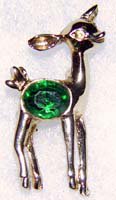
So my Dad decided to buy each of "his girls" a special Christmas pin to wear during the holidays. He bought us pins the first year, and then the second, and so on and so on and so on. My wonderful husband decided to carry my Dad's tradition on after he passed away. So, every year he gives me a Christmas pin. Sometimes he can't decide which one he likes best so I get two special Christmas pins. That's okay with me as I cherish each and every one of them.

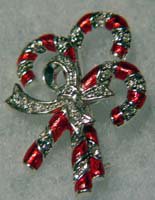
Every year I take them all out and look at them. What always amazes me is how they have changed in design from the first pin I received (the little Bambi deer above) to my latest (the candy canes above). And, believe it or not, I don't have any duplicates. Also (and I know this will be hard to believe), I don't have any "dollies." So, a heartfelt thanks to you Dad for starting this tradition and a heartfelt and sentimental thanks to my husband for continuing his pin tradition.

If you don't have your own special tradition, perhaps this little article will inspire you to start one. May each and every one of you have a wonderful holiday season.


Wednesday, December 21, 2005

Caroling, Caroling, Now We Go Christmas Bells Are Ringing.....

Caroling & carolers - another long lost tradition. Unfortunately, I think the lovely Christmas tradition of caroling for your neighbors has been replaced with collecting caroling dolls. Not that I think collecting any kind of doll is bad. It's just that caroling and singing holiday songs is such a lovely way to wish your neighbors a wonderful, holiday season. So, before we lose the tradition I think we need to understand why the tradition began.

Well, what exactly is a "carol." For most, a carol is a song of rejoicing associated with festive occasions and religious celebrations. The word "caroling" originally meant a circle dance accompanied by a song and carols have carried on the glad tidings of Christmas since medieval times. Unlike hymns, carols are often light and gay.

According to one religious legend, the very first carol was sung by the angels announcing Christ's birth to the shepherds. Some say the tradition of caroling began as early as the 1400s when wandering minstrels performed songs in exchange for donations to be given to the needy. Later, the English night watchmen would sing while making their rounds at holiday times. In the United States, until about 100 years ago carols were limited to only being sung in church. At that time, the practice of singing door to door became a popular and joyous Christmas event.

In the mid 17th century when the celebration of Christmas was banned, the carols might have been lost forever. But, the carols were kept alive for almost 200 years by people singing them in private. With the invention of inexpensive printing processes in the 1800s, traditional carols were published in book form.

The origins of many popular carols, including "God Rest Ye Merry Gentlemen" and "The First Noel," are unknown. However, one of the most famous carols, "Silent Night," was written in Austria by Josef Mohr and church organist, Franz Gruber when the church organ malfunctioned on Christmas Eve. Hurriedly Mohr wrote the song and asked Gruber to pick out a guitar accompaniment. The rest is history.

I can remember caroling as a child. We'd go out on a cold, windy night with our little caroling books and would stop at each of our neighbors houses. I couldn't sing worth beans, but that didn't seem to matter to me. Maybe that's why some of the neighbors never came out. Sometimes our neighbors would offer us hot cocoa, sometimes candy. Most of our neighbors would come outside while we were singing. Some didn't. In any event, it was a joyous event and one that I've never forgotten.

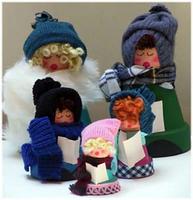
Well, you might not like caroling, but who doesn't love a Christmas Caroler doll. I've never seen one I didn't want (of course, I've never seen a doll I didn't want either.) That's beside the point. Anyways, I've made many caroler dolls myself either out of wood, cloth, terra cotta, pinecones, etc.

When I was a child every Christmas we'd have a family Christmas craft project. One year my Father and I made a white styrofoam church which housed a lighted angel. Outside it was decorated with wax candles (you remember those, don't you?) of lots and lots of carolers. The light from the angel lit up the church's steeple and was such a beautiful sight for many years. Styrofoam, however, doesn't last forever and neither do wax candles. In any event, the tradition of a family Christmas crafting event can be so much fun for the whole family and provide everyone with a lifetime of memories.

If you decide to get the whole family involved in a Christmas crafting project please make sure that while you're crafting that you're singing Christmas carols and have the hot cocoa waiting.

"Caroling, caroling, now we go Christmas Bells are ringing.................." Linda, when are you going to learn how to sing?

Come on everyone, sing along!

Caroling, caroling, now we go
Christmas bells are ringing
Caroling, caroling thru the snow
Christmas bells are ringing
Joyous voices sweet and clear
Sing the sad of heart to cheer
Ding dong, ding dong
Christmas bells are ringing!

Caroling, caroling thru the town
Christmas bells are ringing
Caroling, caroling up and down
Christmas bells are ringing
Mark ye well the song we sing
Gladsome tidings now we bring
Ding dong, ding dong
Christmas bells are ringing!

Caroling, caroling, near and far
Christmas bells are ringing
Following, following yonder star
Christmas bells are ringing
Sing we all this happy morn
"Lo, the King of heaven is born!"
Ding dong, ding dong
Christmas bells are ringing!

Tuesday, December 20, 2005

Who Doesn't Love Christmas Presents!

Who doesn't love Christmas presents? I know I do.

I love to receive them, but the best part is in giving a present and watching the delight on the face of the recipient, especially if it is the face of a child.

When I was a child, I could hardly wait for Christmas. I used to save my allowance all year so that I could buy Christmas presents for my family. If I didn't have the money to buy presents then I made them.

I can remember one Christmas when I was looking around our house to see if I could find the Christmas presents my Mother had hidden all over the house. In particular, I was looking under the bed in my parents room when my Mother caught me with bedspread in hand. YIKES! Caught red-handed.

Well, my Mother decided to teach me a lesson. She opened all the presents and showed me every one of them. She said that my presents would all be wrapped and under the tree on Christmas Day, but the fun would be gone as I would already know what I was getting. That way, she surmised I'd learn my lesson. Well, she was right. I never looked again.

However, my knowing what my presents were that year didn't diminish the enjoyment that I got from the presents that I gave to others.

I still love Christmas and it is still a HUGE holiday in my family. My husband and I spend days wrapping presents. He wraps the presents. I decorate them (for a crafter, so much fun). I'm always trying to come up with new ways to decorate them. Sometimes my recipients don't want to open them. They just look too darn pretty.

In any event, where did the idea of giving Christmas presents come from?

Well, we have to credit St. Nicholas for this. St. Nicholas who was a bishop in Turkey heard of a family with three daughters who were unable to wed as they had no dowry. St. Nicholas had come from a wealthy family and had given up all his worldly possessions to become a bishop. He took 3 bags of gold coins and dropped them down the chimney. The coins landed in the girls stockings that had been hung to dry on the fireplace.

St. Nicholas was caught in the act by the girls father, but he begged him to keep his secret. Two days later, however the entire village heard of his gift and so the tradition of stockings and St. Nicholas began.

For me, there is no better present then a "hug!" Especially if it comes from one of my grandchildren.

Second to that, however, is a "handmade" present. This tradition we have to credit to the Victorians, once again, as the making of Christmas presents was seen as a way to enliven the long winter evenings leading up to Christmas.

The planning and making of gifts started months in advance.

Daughters would help their Mothers with sewing and needlework. Family members spent a lot of time designing personal gifts for each other. Long hours were spent together planning and creating their special gifts.

For the Victorians the notion of a homemade gift was more sentimentally appealing then a gift bought at a store. I, for one, couldn't agree with them more.


Sunday, December 11, 2005

Just Hang Us Anywhere!

Why do crafters love wreaths? Because wreaths are inviting and they convey warmth and warm welcomes. Wreaths can be made of real evergreens or made of fabric, wire, bamboo, pinecones, dried florals, wood, grapevine, straw, combination wood and grapevine, etc. They can be created in any shape and can fit any season. Therefore, the possibilities for decorations are endless.

I'm made numerous kinds of wreaths and have them up all year long varying them by the holiday or season. For me, I like the combination of wood, grapevine, floral, and fabric used in one way or another on one wreath. Kind of combines everything I like to do. I've even found ways to combine my love of dolls with my wreaths.

But, my favorite wreath is a Christmas wreath. Why? I'm not sure. There's just something about the Christmas holidays and the bright red and green colors that draws me to it. Something about the endless possibilities for placement. A Christmas wreath can look good just about anywhere.

So, as usual, I got to thinking about the origins of the Christmas wreath and wanted to find out about this tradition.

When you think about Christmas wreaths the Advent Wreath with all its religious significances may come to mind. Or, just a plain evergreen wreath with a red velvet bow hung on a door might be what you think of.

The Christmas Wreath is usually a circle which symbolizes continuance - and is never ending. Christmas wreaths are traditionally made with evergreens, which symbolize life. They are often decorated with other natural plant parts, such as pine cones, red ribbons and holly berries. But, they can be as varied as any other type of wreath.

As with a lot of traditions, the wreath creation and use dates back to a time when warding off evil spirits was paramount. The idea of the wreath dates back to the ancient Germanic custom of a wreath made of straw and/or evergreen boughs, tied with colorful ribbons (but mostly red and gold) which would be hung on doors to ward off evil spirits and bring good luck to the occupants.

So, if you're looking for something to ward off evil spirits, to convey a warm welcome to your guests, or just for a lovely decoration, then wreaths fit the bill.

"Wreaths can hang inside or outside."
"They don't care."
"They just want to be hung, anywhere."


Tuesday, December 6, 2005

Oh, Don't Stand Under The Mistletoe!

I thought it might be fun to take a look at some of the long lost Christmas celebration traditions, like mistletoe, to see when and where they started. So, let's begin with bells:

Bells - The ringing of bells originated from pagan mid-winter festivities. They believed that the cold, sunless winters made the evil spirits more powerful. One way to drive the evil spirits away was to make a lot of noise. The bells suited this purpose as you could ring a bell while at the same time you were singing or shouting above it. Believe me, if there were evil spirits near me I'd drop the bells and go running for the hills, yelling at the top of my lungs!
Candles - The Christmas Candle is another tradition which evolved from the pagan mid-winter festivities. It was believed that light was also a way to keep evil spirits away. Those evil spirits just won't go away, will they? It was customary in Victorian England to place lighted candles in the windows during the 12 days of Christmas as a sign to weary travelers that food and shelter could be found here. Also, it was a signal that there were no evil spirits there, or so the wanderer thought.

Holly - Holly was considered magical because of its shiny leaves and its ability to bear fruit during the winter. It was believed that in liquid syrup it would stop coughs and that when hung over one's bed would induce sweet dreams. The prickly holly is called "he" (what a surprise) and the non-prickly holly is called "she" (surprise, surprise). Tradition says that the type of holly which is first brought into the house determines who will rule the household for the coming year. My guess would be that A LOT of non-prickly holly is the first to enter the households.

Christmas Pudding - I can't say as if I've ever had Christmas pudding. The tradition surrounding the Christmas pudding originated in the 14th century. It was actually a porridge made by boiling beef and mutton which was combined with raisins, currants, prunes, wines and spices (sounds delicious, doesn't it?) It was made in large copper kettles and prepared several weeks before Christmas with all of the household members particitpating.

Each member of the household had to take their turn at stirring the stew and making a wish. By the 1600's the addition of eggs and breadcrumbs, ale and spirits (of course), improved its taste significantly. As with other Christmas traditions, Christmas pudding was banned during the Protestant Reformation, but re-established as part of the traditional Christmas feast by King George I. Tradition calls for a silver coin to be placed in the pudding along with a ring, button and thimble. Somewhat dangerous, I would think, especially for small children. It was believed that the finders of these objects in their Christmas pudding would be given the gift of wealth, be married within the year or be doomed to bachelor or spinsterhood.

First Footing - This tradition sounds a lot like Santa Claus coming to me. In any event, in some countries, first-footing takes place at the New Year. In England, it occurs on Christmas Day. The first-footer is the first person to enter the house and, according to tradition, is said to let in Christmas. In some areas, he is a professionally hired First Footer (try putting that on your resume) to make sure that the tradition is carried out properly. He carries an evergreen twig, and comes in through the front door. He then passes through the house and exits through the rear (sounds like a burglar to me.) According to tradition, you may give him salt or bread or some other small gift as a symbol of your hospitality. Boy, at least Santa Clause gets cookies. This poor man gets salt and bread. Also, according to tradition he has dark hair, not red and is always a male. I'm not sure what to say about that!

The Kissing Bough (or the Kissing Ball) - Ah! Now this seems like a nice tradition. Until the introduction of the Christmas tree, the kissing bough was the primary piece of decorative greenery in the English Christmas. It was formed in the shape of a double hoop with streamers going up to a central point and was made up of evergreen boughs, holly, ivy, apples, pears, ribbons and other ornaments along with lighted candles. A sprig of mistletoe was hung from its center (wonder what that's for?) As the name implies, any lady who accidentally (yeah, accidentally, like we'd believe that) wanders under the kissing bough has to pay the price and allows herself to be kissed. That's okay as long as you're kissing a prince. With my luck, I'd probably end up kissing a frog. Maybe he'd turn into a prince.
Wassail - The word wassail comes from the Anglo-Saxon term was hale, which means be well. It means to drink a toast to one's health or to express good will at a festive event. The tradition of wassailing, as with a lot of traditions, started as a pagan agricultural festival. In order to increase the yield of the apple orchards, the pagans believed that the trees needed to be toasted in the winter. So, during the twelve days of Christmas, the pagans would visit selected trees from various orchards which were either sprinkled with the wassail mixture, or had a bottle of wassail broken against their trunk. The wassail mixture consisted of mulled ale, cider or wine with sugar, roasted apples or eggs in it.

The Yule Log - We touched on this briefly in another of my Linda's Blog articles. After Christmas all the branches of the tree are removed and the trunk is saved to be decorated in the spring as a "May Pole." After the May Pole ceremonies are finished the decorations are removed and the trunk is cut into pieces. The largest log is then saved for the following Christmas to become the Yule Log.

The tradition of the Yule log has very deep pagan roots, as well. Surprise! Surprise! It stemmed from the Celtic, Teutons, and Druids burning the logs in their winter ceremonies in celebration of the sun. The selection of the log took on the utmost of importance and was surrounded by a ceremony. According to tradition, the largest end of the log is placed into the hearth while the rest of the tree trunk sticks out into the room. The new log is lit from the remains of the previous year's log which had been carefully stored away.

Many superstitions surround the Yule Log. It had to be ignited the first time a flame was put to it or bad luck would surely follow. Also, it had to be lit with a stick saved from the fire from the year before or the house would burn down. And, unless charcoal from the great fire was kept under the family beds for the following year (what fun), the house might be struck by lightning. Burning the log was said to bring good luck in the new year, as well as protection from fire in the home from which it is burned.

Fruitcake - Ah, fruitcakes! Who doesn't love a fruitcake? I for one have never had one. Don't know why. It just never appealed to me to eat something that was over a year old. Plus, I just never really liked the looks of them.

In any event, fruitcakes started with the Romans who needed to find a way to sustain their armies in faraway lands. Lucky Romans! The fruitcake became so popular in Europe that it was a law that fruitcake (also known as plum cake) could only be served on certain holidays and only on the most important milestones (e.g., weddings and funerals). Boy, they must have really loved their fruitcakes!

Prior to the 1700's, crusaders and hunters carried fruitcakes to sustain themselves over long periods of time away from home. Nowadays fruitcake is generally associated with Christmas. It has, however, since the 1700's been used in ceremonial celebrations of all kinds throughout Europe, including religious holidays, harvest celebrations, birthdays and weddings.

Traditionally, the top layer of the wedding cake called the "Bride's Cake", was a dark fruitcake that was removed and stored for the bridal couple to savor on their anniversaries. Oh, Boy! Lucky couple! A separate piece of fruitcake from the "Groom's cake" was wrapped in a wedding napkin, tied with a white ribbon and put at each guest's place at the table. Single women would put it under their pillow to dream of a groom of their own (I'm not sure I'd want to sleep with fruitcake under my pillow.)
Most people today feel that fruitcake is best used as a doorstop, as a gift for someone else, or just plain thrown away. I don't even know anyone who has ever baked a fruitcake. Do you?
This tradition can definitely become a long long tradition from which it is never to return.

Mistletoe - We touched on mistletoe a little in the paragraph above under the Kissing Bough. Mistletoe is a plant with white berries and has been used as a decoration in houses for thousands of years. It's also associated with many pagan rituals. Marriage ceremonies always included kissing under mistletoe. For Scandinavians, the goddess of love (Frigga) is strongly associated with mistletoe. The early church viewed this as a pagan ceremony and tried to stamp it out. In spite of this attempt the mistletoe survived as a Yuletide symbol. The practice of kissing under the mistletoe has persisted, even in song. Hey! People just love to kiss!

Poinsettias - Poinsettas were added to Christmas tradition starting in 1828. According to tradition, Joel Roberts Poinsett, then the first U.S. ambassador to Mexico, imported the plant from Mexico, which had a Christmas "miracle" story about how the plants leaves became red. The Mexicans in the eighteenth century thought the plants were symbolic of the Star of Bethlehem. Thus the Poinsettia became associated with the Christmas season. Personally, I love poinsetta's. I love to put a bunches of different colored small poinsetta plants together in a group and place several groups around the house.

So, now you know where some of these long lost Christmas traditions began. Personally, I think we can all do without the fruitcake, but that's me. Maybe you like your fruitcake. I'll take the Kissing Bough and mistletoe!

"Oh, don't stand under the mistletoe with anyone else but me,"
" anyone else but me! Anyone else but me!"
"No,no!
"Don't stand under the mistletoe with anyone else but me,"
"anyone else but me......."
Come on. Sing along....


Christmas Cards! A Wonderful Tradition!

Christmas Cards are such a wonderful tradition. They allow you to wish your friends and family a happy holiday season. They also provide a way to catch up on what is happening with everyone.

Sadly, however, Christmas Cards are becoming a long lost tradition. People just don't want or have the time anymore to send you a card.

I love Christmas Cards, especially if they contain a handwritten note or handwritten letter. The handwritten note signifies that the person actually stopped to write something to you. In this fast paced, no time for anything world that is important. Some Christmas Cards contain computerized notes informing everyone of what is happening with them and their families. In a computerized world this was bound to happen. This is fine as well.

Why do I love sending and receiving Christmas Cards? Because I love catching up with what is going on whether it's a handwritten note or a computerized letter. I cherish all the Christmas Cards that I have ever received with handwritten notes or computerized letters. For some of my friends this is the only correspondence that we have every year and provides a way for both of us to stay in touch. In fact, I have never thrown a Christmas Card with a handwritten note or computerized letter away. All of them are in my memory books (albeit I'm on Volume #32 now, but...). For someone like me who is getting older my memory books provide a means of looking back and remembering. The Christmas Cards provide the time frame.

I know my family would be astonished by this, too. I have kept every single Birthday card, Valentine's Day card, Anniversary card, Christmas card, etc. that I have ever received from anyone since I was about 7 years old. It's so nice to be able to go back and look at the cards I received and what was said by my beautiful Step-Daughter, Grandmothers, Grandfather, Old Family Friends, and my Father, all of whom are no longer with us. Re-reading them always brings back such warm and cherished memories for me. I know, call me an old softy. I admit it.

Okay, Linda, let's get back on track. Since, we're coming into the Christmas Card giving season I thought it would be a nice idea to take a look at this Christmas tradition for my Linda's Blog. So, where did the tradition of giving Christmas Cards begin?

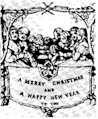
Well (surprise, surprise), it began in Victorian England in 1843, the same year that Charles Dickens wrote "A Christmas Carol." John C. Horsley is actually credited with this, but it was actually at the suggestion of his friend, Sir Henry Cole, that the first Christmas Card was created and published.

It seems that Sir Henry Cole was caught in the mad holiday rush (sound familiar) and was unable to send the traditional written Christmas message to his friends and associates. Instead he sent them an illustrated holiday greeting. The card was divided into three panels and was designed by his friend John C. Horsley. The main illustration showed the three elders at a party raising wine glasses in a toast the side panels showed two Yuletide traditions - feeding the hungry and clothing the needy. The message inside 150 years later is still the most popular greeting of all: "A Merry Christmas and a Happy New Year to you." Henry Cole's cards caused quite a stir. Back then you could send letters for just a penny each (can you imagine 1 penny!)

In the 1860's greeting card companies began appearing all over England. In 1846 Christmas Cards started in America, but didn't really take off until 1920 when advances in printing technology added to the popularity of Christmas Cards. That's also when the color red started being associated with Christmas.

Christmas Cards started due to a mad rush and sadly, their decline may be due to a lack of time during the mad rush of the holiday season. I sincerely hope not. It is such a wonderful and lovely tradition. Sending warm holiday greetings is such a beautiful way to say "A Very Merry Christmas and a Happy New Year To You!"

Have a Happy Holiday Season and a Happy, Healthy, and Safe New Year.

image -http://www.ccdsvictoriantubeheaven.com/

Christmas Means Presents! Doesn't It?

"And the Grinch, with his Grinch-feet ice cold in the snow, stood puzzling and puzzling, how could it be so? It came without ribbons. It came without tags. It came without packages, boxes or bags. And he puzzled and puzzled 'till his puzzler was sore. Then the Grinch thought of something he hadn't before. What if Christmas, he thought, doesn't come from a store. What if Christmas, perhaps, means a little bit more." - Dr. Seuss

If you ask any child, "What does Christmas Mean?" they'd probably reply, "Christmas Means Presents!" But, is that really true? Besides the religious significance of Christmas, what does Christmas really mean? Where did all the Christmas traditions come from?

Christmas Day didn't become official until 354 when Pope Gregory proclaimed December 25th as the date of the Nativity. Pope Gregory was following an early church policy of absorbing pagan rituals into Christian beliefs. So, he incorporated the December 19th Roman Saturnalia celebration of the winter solstice and the coming of spring and the winter festival of Yule into the Christian Church. The Roman Saturnalia honored the God of Harvest and had seven days of riotous merrymaking and feasting. The Yule celebration incorporated giant logs, trimmed with greenery & ribbons, which were burnt in honor of the Gods so the sun would shine brightly.

In the Middle Ages, the Christian Church added the Nativity Crib and Christmas Carols to its customs. Lavish feasting was the highlight of the festivities. However, all the celebration came to an abrupt end in 1652 when the Puritans banned Christmas in England, which was followed seven years later in Massachusetts. Christmas returned to England in 1660, but a lot of the traditions didn't return until they were revived by the Victorians. The Victorians turned what was once a riotous free-for-all celebration into a family-oriented celebration. So, we can thank the Victorians for a lot of the Christmas family traditions that we have today. Not all of them, but a lot of them.

So, I thought it would be fun between now and Christmas to post some articles on my Linda's Blog about the various Christmas traditions and where they came from. So, let's start with one of my favorites "The Christmas Tree":

Christmas trees originated in Germany from an ancient pagan custom of bringing evergreens into your home. Evergreens were a symbol of life. It is said that Dr. Martin Luther (1483-1546)was the first to use the Christmas Tree as a home decoration in Germany. While on a walk one Christmas Eve he noticed an evergreen tree shining in the moonlight. He couldn't forget this beautiful picture so he cut the tree down and returned home with it an decorated it with candles. He told his children that the tree should remind them of the brightness of Christmas and its message of the Savior's birth.

In Germany and in ancient northern cultures, after the December festivities, the branches of the evergreen were removed and the trunk was decorated on May 1st as a May Pole, celebrating a rebirth of spring. The tree was then cut up and the largest log was used the next December as the "Yule Log."

The Christmas Tree was introduced into England in the in 1841 by Prince Albert, husband of Queen Victoria, who brought one into his house for his family. The tradition soon spread throughout England and then to America. However, as with a lot of traditions, the use of Christmas trees also caused an uproar. Some thought it was pagan idol. Eventually, it became acceptable to all.

So, it became fashionable to set up a large tree at Christmas and decorate it with lighted candles (far too dangerous today), candies, and fancy cakes hung from the branches by ribbons and paper chains. Just think, the ants and/or rats would have a field day if we did this today. All of the earliest Christmas tree ornaments were handmade.

The kinds of trees the Victorians chose would surprise you. They were not the fat, wonderfully full trees that we think of today. The first trees were small trees that could be placed on tabletops with a lot of room between the branches. Personally, I think this is kind of nice. In fact, I decided this year to forego the big 7' tree in favor of a 4' pre-lit tree that I'm going to place on a small table covered with a tree skirt. Hopefully, I'll like this smaller tradition and will continue it for years to come.

Most of the early Victorian ornaments were homemade. Homemade paper cornucopias filled with sweets, nuts and popcorn hung on many Victorian Christmas trees. Gingerbread men, popcorn strings (you remember those don't you), gilded nuts, paper ornaments, Paper chains (you remember those, too, don't you) and ribbons. Handmade paper toys and dolls hung from the branches.

Glass ornaments made their appearance in the 1860's, primarily in the homes of German immigrants. Other early ornaments were made of lead, like stars and crosses. Around 1870 "store bought" Christmas ornaments began to replace the homemade decorations. From the 1870's to the 1890's Victorian Christmas trees were trimmed with little dolls (my favorites), wax ornaments, shaped like angels or children. Cotton and wool ornaments were also used and decorated with paper faces, buttons, and paper wings.

In the 1890's technology and consumerism greatly contributed to the way in which Christmas trees were decorated. Many families still used handmade ornaments and made it a tradition with their children to make ornaments every year (a lovely tradition which some families still do today.) In 1903 the first strings of electric lights were invented and in the 1960's the artificial Christmas tree came to be.

For me, I prefer the smell of a real Christmas tree and homemade ornaments. However, real trees are far too dangerous (and too much work) and I too succumbed to using an artificial Christmas tree (very nice, but still artificial.) My ornaments, on the other hand, are all handmade. And, guess what? Yes, (this will come as a surprise to most of you) they are mainly dolls or florals. So, enjoy your Christmas tree however you decorate it and remember the words of these famous quotes:

"I have been looking on, this evening, at a merry company of children assembled round that pretty German toy, a Christmas Tree. The tree was planted in the middle of a great round table, and towered high above their heads. It was brilliantly lighted by a multitude of little tapers; and everywhere sparkled and glittered with bright objects." - Charles Dickens

"Never worry about the size of your Christmas tree. In the eyes of children, they are all 30 feet tall." Larry Wilde

Animated Tree Graphics by Victoriana.com, The Victorian Era Online