
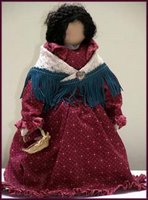
I figured that there had to be a history of faceless dolls or, at least, some cultures and norms. Believe it or not but there isn't a lot of information on either the history of faceless dolls or cultures and norms that started such a tradition.
There is some information on two of the most popular and widely known faceless dolls - Amish dolls and Corn husk dolls. And there is the legend surrounding Raggedy Ann and "faceless" dolls. I was also surprised that there wasn't more information on "faceless" dolls throughout history. I thought for sure that they had to have been around for a long, long time.
In doing my research, what I was pleasantly surprised with was the application of "faceless" dolls for so many current charities or organizations. More on that a little later.

Probably the oldest legend has to do with "faceless" Corn-husk dolls. Some say they are the oldest form of doll known in America. The corn-husk doll shown to the right is a picture of a corn-husk doll that is in the USU Museum of Anthropology.
According to Iroquois legend the Iroquois people had three sisters - corn, beans, and squash or the "sustainers of life." The corn spirit wanted to do something extra for her people so the Creator allowed her to create a beautiful doll from her husks which was to roam the earth and bring brotherhood and contentment to the Iroquois nation. The doll went from village to village playing with the children. Everywhere she went everyone would tell her how beautiful she was.
One day this very, very beautiful doll went into the woods and saw herself in a pool of water. She saw how very, very beautiful she was and this caused her to become very vain and naughty. Kind of sounds like my "Celia" doll, doesn't it? Anyway, the dolls vanity and attitude did not sit well with the people or the Creator. The Creator warned her that this was not the right kind of behavior. She paid attention for a while (as all dolls do) but caught sight of herself in a pool of water again and thought to herself how beautiful indeed she was.
Suddenly out of the sky came a giant screeching owl that snatched her reflection right out of the water. When she looked again at the poll of water she saw nothing. This was her punishment. She would have no face and would roam the earth forever looking for something to redeem herself. Iroquois mothers passed the legend and "faceless" corn husk dolls down to their children to remind them that vanity is a bad thing and that they are not better than anyone else.
The Amish have strong religious beliefs which influence their daily lives. Their dress is plain and simple and so are the dolls they make for their children. According to the Amish tradition, the Bible says that you are not supposed to make anything that is in the image or likeness of a male or female. For that reason the dolls are "faceless."
In some Amish homes even "faceless" dolls were forbidden. Instead of a doll the children were given a piece of wood wrapped in a blanket. Since very few toys were allowed in an Amish household, boys and girls both played with the dolls. Both boy and girl dolls were made.
If you were to examine an old Amish doll you might see 4 or 5 layers of cloth on the head or the body. If the doll became too dirty, ripped or worn then it was covered with a new piece of material.
Most Amish women have been making dolls ( faceless and with faces) for their children for generations. This tradition has become a cottage industry for the Amish community. The picture top and left is of a popular "faceless" Amish boy and girl doll.
Over 20 years ago I bought a similar set of "faceless" Amish dolls. My dolls had on burgundy and black outfits but, pretty much, looked like the picture. I would have included a picture of my two "faceless" Amish dolls in this article but I can't remember where they are right now. They're here somewhere.
As far as Raggedy Ann is concerned, one of the legends surrounding her creation is that a little girl was rummaging around her Grandmother's attic and finds a faceless, battered old doll. She brings the doll into her fathers art studio and tells him all about finding it in the attic. He looks at his daughter and the faceless doll and decides to draw a whimsical face on it and then tells her to see if her Grandmother would sew two button eyes on. And so Raggedy Ann was born.
In doing my research on faceless dolls I was delighted to run across some websites concerning the application of "faceless" dolls today and why they were chosen or made "faceless." One of the websites concerned the Children With Aids Project (CWA) which was created by Joy and Jim Jenkins. CWA offers a variety of services to children infected or affected by AIDS. One of these services is giving "faceless" dolls to the children infected or affected by Aids. Why did they decide to make and sell "faceless" dolls. Because AIDS is a "faceless" disease. According to their CWA website, by buying one of the dolls you can support their mission to recruit families to provide loving, caring permanent homes for the HIV infected, affected and orphaned children.
Another article about "faceless" dolls concerned the dolls of Gloria Larocque. She has created 100 or more "faceless" dolls based upon the Iroquois legend that warns young girls about the dangers of vanity. According to the article her purpose, however, is different. Her dolls represent Canada's murdered aboriginal women, a group made faceless not by vanity but by neglect. Her project has helped draw attention to the plight of the murdered aboriginal women.
On the Girl Scouts of South Jersey Pines (GSSJP) website there was an article about a Girl Scout who made and donated 32 faceless dolls to the Pediatrics Department of the Salem Memorial Hospital to help ease the childrens fears of being in the hospital. The dolls were made out of muslin with bright striped and tye-dyed polar fleece t-shorts. The faces were left blank. Attached to each doll was a piece of paper that told the child to "give the doll a face to make it their own."
And, finally, there was article by Brenda Tobias on the Cornell University website concerning Hurricane Katrina and something the alumni did to help the children affected by Hurricane Katrina. A group of 100 alumni got together to sew "faceless" dolls for the children. Doll decorating kits and coloring books were assembled and sent to the children to comfort them.
I think you all know that I, personally, love faceless dolls. Victorians, primitives, country style. It doesn't matter. I love them all.
Why do I love the faceless doll so much? Because I think be being "faceless' the doll can be anything you want him or her to be.
You create the dolls personality to be exactly what you want it to be.
And, as we've seen from the above mentioned articles the application can be heartwarming, meaningful and beautiful.


 Happy Valentine's Day, tomorrow, to all the "young at heart" lovers of the world. I said "young at heart" so that no one would feel left out. Young, old, single, married, anyone with a pulse!
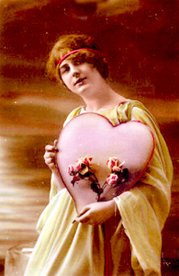 Valentine's Day didn't get imported into the U.S. until the 19Th century and was brought by British settlers. Most of the valentines back then were hand written. The 1st mass produced valentines were on embossed paper and were sold around 1847 by Esther Howland of Worcester, Massachusetts. Her father had a stationary store and she loved an English valentine she had received so she decided to create her own. She made her elaborate creations with real lace, ribbons, and colorful pictures known as "scrap." Kind of sounds like today's version of scrapbooking. The picture to the right is a Valentine's Day postcard, circa 1910.
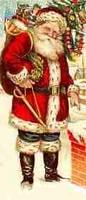 I can remember my Mother telling me that, as I'm sure most of you can too. We all know Santa as the familiar image with his red suit, sled or sleigh, reindeer's, and sacks of toys delivering packages to
 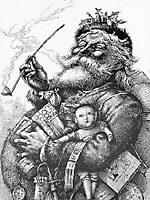 Thomas Nast helped create the kinder, more fatherly, plumper Santa as we know him today. But, Thomas Nast wasn't the only person to contribute to this legend. Clement Clarke Moore was a huge contributor as in 1822 he published his poem "A visit From St. Nicholas," bittern known as "The Night Before Christmas." His poem is the first mention of a sleigh powered by "eight tiny reindeer" and mentioning their names.
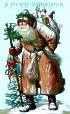 The legend of Father Christmas, however, is ancient and far more complex. Part of the legend is attributed to St. Nicholas and part to a jovial medieval figure in the "Spirit of Christmas." In Russia, Father Christmas carries a piglet under one arm. St. Nicholas is also know as Santa Claus, Father Christmas, Heilige Nikolaus, and Pere Noel.
 If you're a reader of my
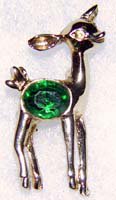
 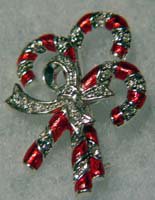 Every year I take them all out and look at them. What always amazes me is how they have changed in design from the first pin I received (the little Bambi deer above) to my latest (the candy canes above). And, believe it or not, I don't have any duplicates. Also (and I know this will be hard to believe), I don't have any "dollies." So, a heartfelt thanks to you Dad for starting this tradition and a heartfelt and sentimental thanks to my husband for continuing his pin tradition.
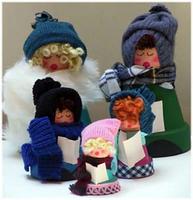 Caroling & carolers - another long lost tradition. Unfortunately, I think the lovely Christmas tradition of caroling for your neighbors has been replaced with collecting caroling dolls. Not that I think collecting any kind of doll is bad. It's just that caroling and singing holiday songs is such a lovely way to wish your neighbors a wonderful, holiday season. So, before we lose the tradition I think we need to understand why the tradition began.
 Who doesn't love Christmas presents? I know I do.
 For me, there is no better present then a "hug!" Especially if it comes from one of my grandchildren.
 Why do crafters love wreaths? Because wreaths are inviting and they convey warmth and warm welcomes. Wreaths can be made of real evergreens or made of fabric, wire, bamboo, pinecones, dried florals, wood, grapevine, straw, combination wood and grapevine, etc. They can be created in any shape and can fit any season. Therefore, the possibilities for decorations are endless.
 Christmas wreaths are traditionally made with evergreens, which symbolize life. They are often decorated with other natural plant parts, such as pine cones, red ribbons and holly berries. But, they can be as varied as any other type of wreath.
 "Wreaths can hang inside or outside."
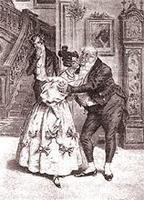 I thought it might be fun to take a look at some of the long lost Christmas celebration traditions, like mistletoe, to see when and where they started. So, let's begin with bells:


 Christmas Cards are such a wonderful tradition. They allow you to wish your friends and family a happy holiday season. They also provide a way to catch up on what is happening with everyone.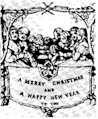
 Christmas Cards started due to a mad rush and sadly, their decline may be due to a lack of time during the mad rush of the holiday season. I sincerely hope not. It is such a wonderful and lovely tradition. Sending warm holiday greetings is such a beautiful way to say
  "And the Grinch, with his Grinch-feet ice cold in the snow, stood puzzling and puzzling, how could it be so? It came without ribbons. It came without tags. It came without packages, boxes or bags. And he puzzled and puzzled 'till his puzzler was sore. Then the Grinch thought of something he hadn't before. What if Christmas, he thought, doesn't come from a store. What if Christmas, perhaps, means a little bit more." - Dr. Seuss
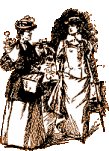 Tomorrow is the biggest shopping day of the year. The day after Thanksgiving, the traditional start of the holiday shopping season. Plus, Monday is the biggest shopping day of the year for internet sales. Given that,I thought it might be fun to take a look at some of the Victorian rules of etiquette for shopping to see if they could be applied to today.
 Thursday when we sit down for Thanksgiving dinner we will give thanks for all we have, remembrances of our dear and departed loved ones, and prayers of good health for our families and friends. There are so many ways to says thanks and express gratitude for all we have. Below are a few famous Thanksgiving quotes:
 Boy, time really does fly when you're having fun. It's almost November 24Th, 2005 - Thanksgiving Day. Soon, gobble, gobble, gobble day will be upon us and we'll all be feasting until are stomachs are bulging (at least some of us will). I think we should call it calories, gobble, gobble day! Don't you?
 It's hard to believe that we are already at the time of year when it will be snowing once again. In fact, it has already snowed an inch here and they are predicting snow for Thanksgiving Day. The good news is that it will melt quickly. The bad news is we're just at the start of the season. Oh, joy!
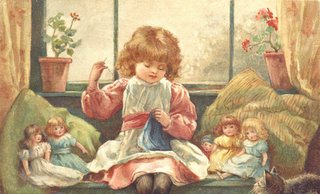 Don't you just love this picture. I do. It reminds me of the countless times I had to mend my doll and/or their clothes. This picture was part of the Vintage Workshop package of FREE Holiday Art Download made available to subscribers of Country Marketplace magazine in their October 2005 issue.